


For decades, the 4% rule has been one of the most recognizable guidelines in retirement planning. The basic idea is simple: withdraw approximately 4% of your investment portfolio when you retire, adjust that dollar amount for inflation in future years, and your savings should have a reasonable chance of lasting through a 30-year retirement.
But retirement rarely follows a formula. How long you live, when you retire, how markets perform, how much guaranteed income you receive, how flexible your spending is, and how your withdrawals are taxed can all change how much you can reasonably spend.
So, does the 4% rule still work? It can still be a useful starting point, but 4% isn't a retirement plan—and it isn't the right withdrawal rate for everyone.

What Is the 4% Rule?
The 4% rule originated with research by financial planner William Bengen. His original research examined historical market periods to determine how much a retiree could initially withdraw from an investment portfolio while sustaining withdrawals over approximately 30 years.
The rule is often misunderstood as withdrawing 4% of your current portfolio every year. That's not how the traditional approach works.
If you retired with $1 million, for example, a 4% initial withdrawal would equal $40,000 during the first year. Future withdrawals would generally adjust that $40,000 amount for inflation rather than recalculating 4% of the portfolio's new value each year.
The rule was designed to answer a useful planning question: How much could someone initially withdraw without exhausting their portfolio during a historically difficult retirement period?
It was never intended to tell every retiree exactly how much they should spend.
Is the 4% Rule Outdated?
Recent headlines have questioned whether 4% is still the appropriate number. The answer isn't as simple as replacing 4% with a new universal withdrawal rate.
Bengen has continued expanding his original research and has discussed an initial withdrawal rate closer to 4.7% under his updated assumptions. Other retirement research has produced lower starting withdrawal rates under different assumptions.
That doesn't necessarily mean one number is right and the others are wrong. Withdrawal-rate research can vary based on the investments included, retirement length, historical periods studied, inflation assumptions, spending strategy, and definition of a successful retirement.
Instead of debating whether the correct number is 3.9%, 4%, or 4.7%, retirees should understand something more important: your appropriate withdrawal rate depends on your retirement.
Why Your Retirement Withdrawal Rate May Be Higher or Lower
A 4% starting point assumes a particular type of retirement. Change those assumptions, and the amount you can comfortably withdraw may change too.
How Long Does Your Money Need to Last?
Retirement length matters. Someone retiring at 55 may need a portfolio to support 40 years or longer, while someone retiring at 70 is planning around a different time horizon.
Of course, no one knows exactly how long retirement will last. That's why a retirement plan should consider longevity without assuming everyone needs the exact same withdrawal strategy.
How Much Income Will You Receive From Other Sources?
Your investment portfolio may not need to support your entire lifestyle.
Social Security, pensions, rental income, part-time work, or other reliable income sources can reduce the amount that needs to come from investments.
When Should You Take Social Security? 62 vs. 67 vs. 70
For example, a household spending $100,000 annually but receiving $50,000 from Social Security and pension income has a very different portfolio need from a household spending the same amount with no outside income.
How Is Your Portfolio Invested?
A sustainable withdrawal strategy also depends on what is happening inside the portfolio.
Holding too little growth-oriented exposure may make it harder for assets to keep pace with a long retirement and inflation. Taking too much investment risk can expose a retiree to significant losses at a time when withdrawals are also occurring.
The appropriate investment mix depends on the household's income needs, risk tolerance, time horizon, and other resources—not simply a predetermined withdrawal percentage.
How Flexible Is Your Spending?
The traditional 4% framework assumes relatively consistent inflation-adjusted withdrawals. Actual retirees may have more flexibility.
If markets experience a significant decline, some households can postpone a large vacation, delay a vehicle purchase, or temporarily reduce discretionary spending. Others may have little room to adjust because most of their withdrawals cover essential expenses.
That distinction matters. The ability and willingness to adjust spending can influence how aggressively someone can approach portfolio withdrawals.
What Are Your Legacy Goals?
Not running out of money and leaving a significant inheritance are two different objectives.
One retiree may be comfortable spending down a substantial portion of the portfolio during retirement. Another may want to preserve assets for children, grandchildren, charity, or another purpose.
A withdrawal strategy should account for what you want the portfolio to accomplish—not just whether it lasts until the end of retirement.
Taxes Matter When Determining How Much You Can Spend
A $50,000 portfolio withdrawal doesn't necessarily provide $50,000 of spendable income.
Where the money comes from matters. Withdrawals from traditional IRAs and 401(k)s are generally taxable as ordinary income, while qualified Roth IRA distributions are generally tax-free. Selling investments in a taxable account can create capital gains or losses depending on the investment and cost basis.
Withdrawals can also interact with other parts of the financial plan, including the taxation of Social Security benefits and Medicare premiums.
This is why retirement planning should focus on after-tax spending, not simply a gross withdrawal percentage.

Your Retirement Spending Probably Won't Be a Straight Line
The 4% rule provides a clean mathematical framework. Real retirement spending tends to be less predictable.
You might travel extensively during the first several years of retirement, purchase a vehicle, renovate your home, help a child or grandchild, or make a large charitable gift. Later, travel and discretionary spending may decline while healthcare or support expenses increase.
5 Years Before Retirement: What Should You Be Doing Now?
Instead of assuming you'll spend exactly the same inflation-adjusted amount every year, build expected large expenses and changing lifestyle needs into the retirement plan.
That can provide a much more useful answer to the question retirees actually care about: How much can I afford to spend?
What Happens If the Market Falls Right After You Retire?
One of the biggest risks to a retirement withdrawal strategy is experiencing poor investment returns during the first several years of retirement.
This is known as sequence-of-returns risk.
Imagine two retirees who ultimately experience similar long-term average investment returns. One experiences strong markets during the first several years of retirement and poor markets later. The other experiences the same general returns in the opposite order.
Their outcomes can be very different.
When markets fall while you're also withdrawing money, you may have to sell investments at depressed values to fund spending. Those dollars are no longer invested when markets eventually recover, potentially making it more difficult for the portfolio to rebound.
A retirement income strategy therefore shouldn't exist separately from the investment strategy. The two need to work together.
What Determines Your Retirement Withdrawal Rate?
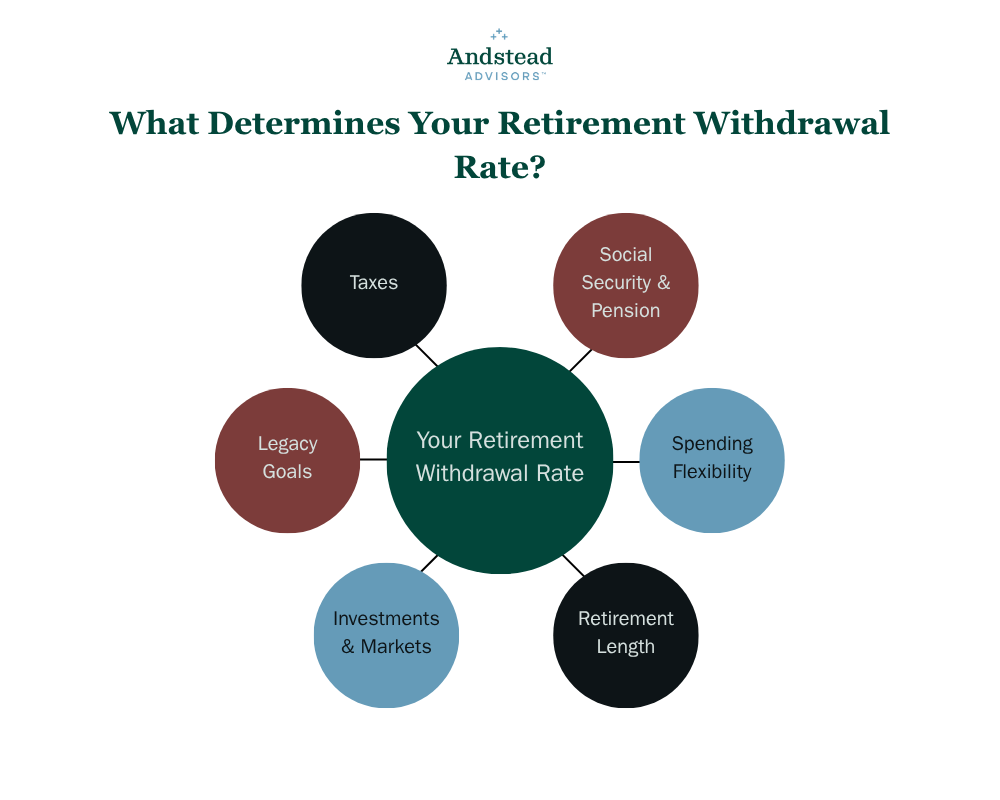
Rather than choosing a percentage in isolation, consider the major factors influencing your retirement income plan:
- Retirement length
- Social Security and pension income
- Portfolio allocation and market returns
- Taxes
- Spending needs and flexibility
- Healthcare expenses
- Large future purchases
- Legacy goals
Two households with identical $1 million portfolios could reasonably have very different spending plans because the rest of their financial lives look completely different.
The 4% Rule Is a Starting Point, Not a Retirement Plan
The 4% rule remains useful because it gives retirees a simple framework for thinking about how portfolio size relates to retirement income. It can also provide a quick starting point when you're years away from retirement and trying to estimate whether you're on track.
But once retirement gets closer, a general rule should give way to an actual retirement income plan.
Instead of asking only: “Can I withdraw 4%?” Ask: “How much can I spend while supporting the retirement I actually want?”
Answering that requires bringing together your investments, Social Security, pensions, taxes, healthcare, expected spending, large purchases, longevity, and legacy goals. It also means revisiting the plan as markets, tax laws, spending, and your life change.
The goal isn't to find the perfect withdrawal percentage on the day you retire. It's to build a retirement income strategy that can adjust with you throughout retirement.

Frequently Asked Questions
Q: What is the 4% rule for retirement?
A: The 4% rule is a retirement withdrawal guideline that suggests withdrawing approximately 4% of your investment portfolio in the first year of retirement and then adjusting that dollar amount for inflation in future years. It was developed as a framework for sustaining withdrawals over a roughly 30-year retirement.
Q: Does the 4% rule still work?
A: The 4% rule can still be a useful starting point, but it isn't appropriate for every retiree. Retirement length, investment allocation, market performance, Social Security and pension income, taxes, spending flexibility, and legacy goals can all affect an appropriate withdrawal strategy.
Q: How much can I safely withdraw from my retirement savings each year?
A: There isn't one safe withdrawal rate that applies to everyone. How much you can reasonably withdraw depends on factors including your age, expected retirement length, portfolio, other income sources, spending needs, taxes, and willingness to adjust spending over time.
Q: Does the 4% rule include Social Security?
A: The 4% rule specifically addresses withdrawals from an investment portfolio. Social Security, pensions, and other income sources should be considered separately when determining how much your portfolio actually needs to provide each year.
Q: Do you withdraw 4% of your portfolio every year?
A: Not under the traditional 4% rule. The approach generally starts with a withdrawal equal to approximately 4% of the initial portfolio and then adjusts that dollar amount for inflation in subsequent years rather than recalculating 4% of the portfolio annually.
Q: What is sequence-of-returns risk in retirement?
A: Sequence-of-returns risk is the possibility that poor investment returns early in retirement can have an outsized effect on how long a portfolio lasts. Market losses can be especially damaging when they occur while a retiree is simultaneously withdrawing money from the portfolio.
Q: Should I use the 4% rule to plan my retirement income?
A: The 4% rule can be helpful for estimating retirement income, particularly when retirement is still years away. As retirement approaches, a more personalized plan should account for Social Security, pensions, taxes, investments, healthcare, spending, major expenses, longevity, and legacy goals.
About Andstead Advisors
Andstead Advisors is an independent financial planning and wealth management firm headquartered in Denver's Denver Tech Center, serving individuals, families, retirees, and business owners throughout Colorado and across the country. Our team provides comprehensive financial planning, investment management, retirement planning, business owner solutions, retirement plan consulting, business succession planning, cash balance plan strategies, profit sharing plans, and Solo 401(k) guidance. As fiduciary advisors, we help clients make informed financial decisions through personalized advice, long-term planning, and ongoing partnership designed to support their financial goals at every stage of life.