


Broker Check
5 Years Before Retirement: What Should You Be Doing Now?

5 Years Before Retirement: What Should You Be Doing Now?

August 13, 2026

Five years before retirement is when planning starts to become much more concrete. You are close enough to estimate what retirement may actually look like, but you still have time to make meaningful changes if the numbers aren't lining up the way you expected.

At this stage, retirement planning should shift from simply accumulating as much as possible to figuring out how all the pieces will work together once your paycheck stops. Your spending, Social Security, investments, taxes, healthcare, debt, and retirement income strategy all need to support the same plan.


1. Get Specific About What Retirement Will Cost

Start by estimating what you actually expect to spend in retirement. Some expenses may decrease when you stop working, while others—such as travel, hobbies, healthcare, or time with family—could increase. Separate your essential expenses from discretionary spending so you understand both what you need and where you have flexibility.

It can also be helpful to test your assumptions before retirement. Fidelity recommends trying to live on your anticipated retirement budget before you actually retire, while 1st Source suggests testing major lifestyle decisions, such as relocating, in advance. A trial run can reveal expenses or lifestyle preferences that are difficult to predict on paper.


2. Determine Where Your Retirement Income Will Come From

Once you have a reasonable estimate of your retirement expenses, map out the income available to support them. Social Security, pensions, investment accounts, retirement plans, cash savings, rental income, or other sources may all play a role.

Then determine how much of your spending will need to come from your portfolio. This is an important shift in retirement planning: instead of simply asking “Have I saved enough?”, start asking “How will the money I've saved actually provide the income I need?” Building that retirement income plan several years in advance gives you time to adjust your savings, spending, or retirement date if necessary.


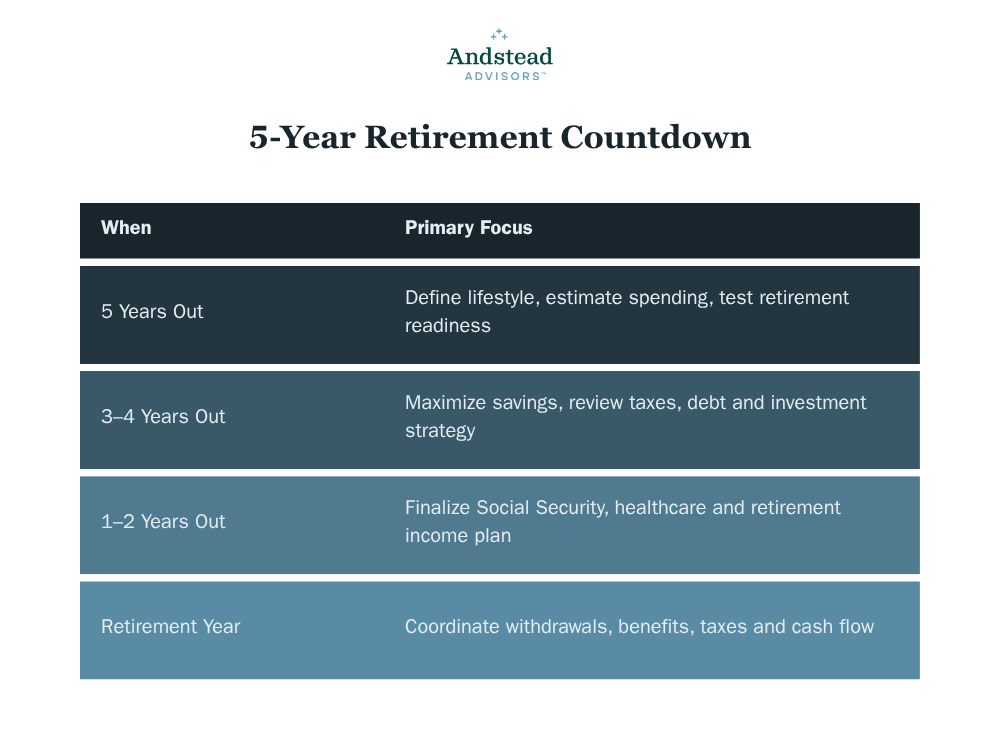
5-year retirement countdown showing what to review before retirement, including spending, income, Social Security, taxes, investments, healthcare, savings, and debt.


3. Make a Social Security Decision Part of the Plan

You don't necessarily need to decide exactly when you'll claim Social Security five years before retirement, but you should begin evaluating your options. Claiming earlier provides income sooner, while delaying benefits can increase your monthly benefit, subject to Social Security rules.

The important thing is to evaluate Social Security alongside your other retirement income rather than treating it as a separate decision. Your retirement date, spouse's benefits, portfolio withdrawals, taxes, longevity expectations, and other income sources can all influence the strategy.

When Should You Take Social Security? 62 vs. 67 vs. 70


4. Take Advantage of Your Final Years to Save

Your last several working years can be an important opportunity to strengthen your retirement savings. Review how much you're contributing to your 401(k), 403(b), IRA, HSA, or other available accounts and whether you're taking full advantage of applicable catch-up contribution opportunities.

This is also a good time to look beyond contribution percentages and evaluate where you're saving. The mix of pretax, Roth, and taxable assets you bring into retirement can affect the flexibility you have when deciding where future income should come from. Fidelity similarly emphasizes maximizing tax-advantaged savings and applicable catch-up opportunities during the final years before retirement.


5. Start Planning for Taxes Before You Retire

Retirement can change your tax situation significantly. Your paycheck may disappear, but you'll begin making decisions about Social Security, retirement account distributions, investment gains, pensions, and eventually required minimum distributions.

The years immediately before and after retirement can also create tax-planning opportunities. Depending on your situation, strategies involving Roth conversions, charitable giving, capital gains, or the timing of retirement withdrawals may be worth evaluating. Rather than waiting until after retirement to think about taxes, start considering how your income may change from year to year and coordinate tax-sensitive decisions with your tax professional.


6. Review Your Investment Strategy for Retirement

An investment strategy designed primarily to accumulate money may need to evolve as you approach the point when you'll begin withdrawing from the portfolio. That doesn't necessarily mean becoming extremely conservative, since your retirement savings may still need to support decades of spending and growth.

Instead, evaluate how much risk you're taking and what would happen if markets declined shortly before or after you retire. Having an appropriate mix of investments and sufficient liquidity can help reduce the likelihood that you'll need to sell investments at an unfavorable time simply to fund normal expenses.


7. Make a Plan for Healthcare and Medicare

Healthcare can be one of the biggest variables in a retirement plan, particularly if you're considering retiring before becoming eligible for Medicare at age 65. If there will be a gap between retirement and Medicare eligibility, determine how you'll obtain coverage and what it could cost. Fidelity specifically identifies health insurance as an additional expense that needs to be planned for when retiring before Medicare eligibility.

As you approach 65, Medicare itself becomes part of the planning process. Enrollment timing, supplemental coverage, prescription drug coverage, and potential income-related Medicare premiums should be considered alongside your retirement date and tax strategy.


5-year retirement countdown showing what to review before retirement, including spending, income, Social Security, taxes, investments, healthcare, savings, and debt.


8. Take Care of Major Financial Decisions While You're Still Working

The years before retirement are also a good time to look at major expenses and debts that could affect your future cash flow. High-interest debt may deserve particular attention, while decisions about a mortgage should be evaluated within the context of your overall retirement plan rather than assuming all debt must disappear before you retire.

Consider upcoming expenses as well. If your home may need a new roof, you expect to replace a vehicle, or another major purchase is on the horizon, planning for it while you still have employment income may prevent an unexpected expense from disrupting your retirement plan. Fidelity similarly recommends evaluating major purchases and home projects before retirement when appropriate.

Should I Pay Off My Mortgage Before Retirement?


Don't Forget to Plan for the Life, Not Just the Money

A retirement plan can work perfectly on paper and still leave one major question unanswered: What are you actually retiring to?

Think about where you want to live, how you'll spend your time, what relationships and activities will be important to you, and what will provide purpose when work is no longer structuring your week. 1st Source specifically recommends testing potential living arrangements and developing interests, volunteer opportunities, or other sources of purpose before retirement rather than assuming you'll figure them out afterward.

Those decisions have financial implications too. A retirement built around frequent travel looks different from one centered around family and community, and relocating can change housing costs, taxes, transportation, and healthcare. Defining the lifestyle makes it much easier to determine whether the financial plan actually supports it.


Your 5-Year Retirement Countdown

Five years out, the priority should be testing whether your desired retirement lifestyle and financial resources align. Over the next several years, you can refine your savings, tax strategy, investments, debt, and major spending decisions as the picture becomes clearer.

By the final year, the focus should shift toward execution: confirming your retirement date, healthcare coverage, Social Security strategy, cash reserves, portfolio withdrawals, and how you'll replace the paycheck you've relied on throughout your working years.

Five Years Gives You Something Valuable: Time

Finding out five months before retirement that your plan doesn't work can leave you with difficult choices. Finding out five years before retirement gives you options.

You may be able to save more, adjust spending, work a little longer, reconsider when you claim Social Security, change how you're invested, reduce debt, or take advantage of tax-planning opportunities before retirement. You may also discover that you're in better shape than you thought.

The goal during the five years before retirement isn't to predict exactly what the next 30 years will look like. It's to identify the biggest decisions while you still have time to make thoughtful adjustments.

By the time your final paycheck arrives, retirement shouldn't feel like the moment you start figuring out the plan. It should feel like the moment you begin using the plan you've already built.


Frequently Asked Questions

Q: What should I do 5 years before retirement?
A: Five years before retirement, start turning your savings into a specific retirement plan. Estimate your future spending, identify retirement income sources, review Social Security and healthcare decisions, evaluate your investments and taxes, maximize remaining savings opportunities, and address major expenses or debt.

Q: How do I know if I'm financially ready to retire?
A: Retirement readiness depends on more than reaching a specific savings number. Compare your expected retirement expenses with Social Security, pensions, investments, and other income sources, then determine how much your portfolio will need to provide. Your plan should also account for taxes, healthcare, inflation, and unexpected expenses.

Q: How much money should I have saved 5 years before retirement?
A: There isn't one savings target that works for everyone. The amount you need depends on your expected spending, retirement age, Social Security and pension income, investment assets, taxes, healthcare costs, and how long your savings may need to last. A retirement income projection can provide a more useful answer than a general savings benchmark.

Q: Should I change my investments 5 years before retirement?
A: It's a good time to review your investment strategy, but approaching retirement doesn't necessarily mean moving everything into conservative investments. Consider your withdrawal needs, cash reserves, time horizon, risk tolerance, and how your portfolio would support spending during a market downturn.

Q: Should I pay off debt before I retire?
A: It depends on the type of debt, interest rate, monthly payment, and resources required to eliminate it. High-interest debt may deserve priority, while paying off a low-rate mortgage may not always be the best use of retirement assets. Consider how eliminating debt affects both your monthly cash flow and liquidity.

Q: When should I start planning for Social Security and Medicare?
A: Both should be considered before retirement rather than waiting until you need to enroll or claim benefits. Social Security timing can affect your lifetime retirement income, while healthcare planning is especially important if you plan to retire before becoming eligible for Medicare at age 65.

Q: Why is tax planning important before retirement?
A: Retirement can significantly change your taxable income. The years surrounding retirement may create opportunities to evaluate Roth conversions, retirement-account withdrawals, capital gains, charitable giving, and other tax-sensitive decisions before required minimum distributions begin.


About Andstead Advisors

Andstead Advisors is an independent financial planning and wealth management firm headquartered in Denver's Denver Tech Center, serving individuals, families, retirees, and business owners throughout Colorado and across the country. Our team provides comprehensive financial planninginvestment managementretirement planningbusiness owner solutions, retirement plan consulting, business succession planning, cash balance plan strategies, profit sharing plans, and Solo 401(k) guidance. As fiduciary advisors, we help clients make informed financial decisions through personalized advice, long-term planning, and ongoing partnership designed to support their financial goals at every stage of life.