


For successful business owners who are already maximizing a 401(k), finding additional ways to save for retirement can become increasingly important. A cash balance plan can provide another opportunity to build retirement assets while potentially creating meaningful tax deductions for the business.
However, a cash balance plan is more complex than simply increasing your 401(k) contribution. It is a type of defined benefit pension plan with funding requirements, actuarial calculations, administrative costs, and employee considerations. For the right business, those tradeoffs can be worthwhile, but a cash balance plan should be designed around the business rather than chosen solely because of its contribution potential.
What Is a Cash Balance Plan?
A cash balance plan is a type of defined benefit retirement plan. Unlike a traditional pension that typically describes the benefit as a monthly payment in retirement, a cash balance plan expresses a participant's benefit as a hypothetical account balance. That account generally grows through employer-provided pay credits and interest credits established by the plan.
Although the account format can make a cash balance plan look similar to a 401(k), the two plans work differently. A 401(k) is a defined contribution plan, where contributions are made to an individual's actual investment account. With a cash balance plan, the promised retirement benefit is defined by a formula, and an actuary determines how much the employer needs to contribute to fund those benefits.
Why Do Business Owners Consider Cash Balance Plans?
The primary appeal is the opportunity to save more for retirement. In 2026, the general defined contribution limit for a 401(k) and profit-sharing plan is $72,000 before applicable catch-up contributions. Cash balance plans operate under different defined benefit rules, so certain business owners may be able to make substantially larger employer contributions when a cash balance plan is added to their retirement strategy.
Employer contributions to a qualified defined benefit plan may also be deductible, subject to applicable rules and limitations. For a profitable business owner who wants to accelerate retirement savings, the combination of increased retirement funding and potential business tax deductions can make a cash balance plan particularly attractive.
The key word, however, is potential. There isn't one universal cash balance plan contribution limit that every owner can contribute each year. The amount depends on the plan design and actuarial calculations, which is why contribution illustrations should be specific to the business and its participants.
Cash Balance Plan vs. 401(k): What's the Difference?
A 401(k) and cash balance plan aren't necessarily competing choices. In fact, businesses can maintain both types of retirement plans, and combining them can create a powerful retirement strategy for certain owners. The IRS specifically notes that employers sponsoring defined benefit plans can also maintain other retirement plans.
A 401(k) gives participants control over their employee contributions and investments within the plan. A cash balance plan is employer-funded based on the plan's benefit formula and requires actuarial oversight. That additional structure can create greater retirement savings opportunities, but it also brings greater complexity and a more significant funding commitment.
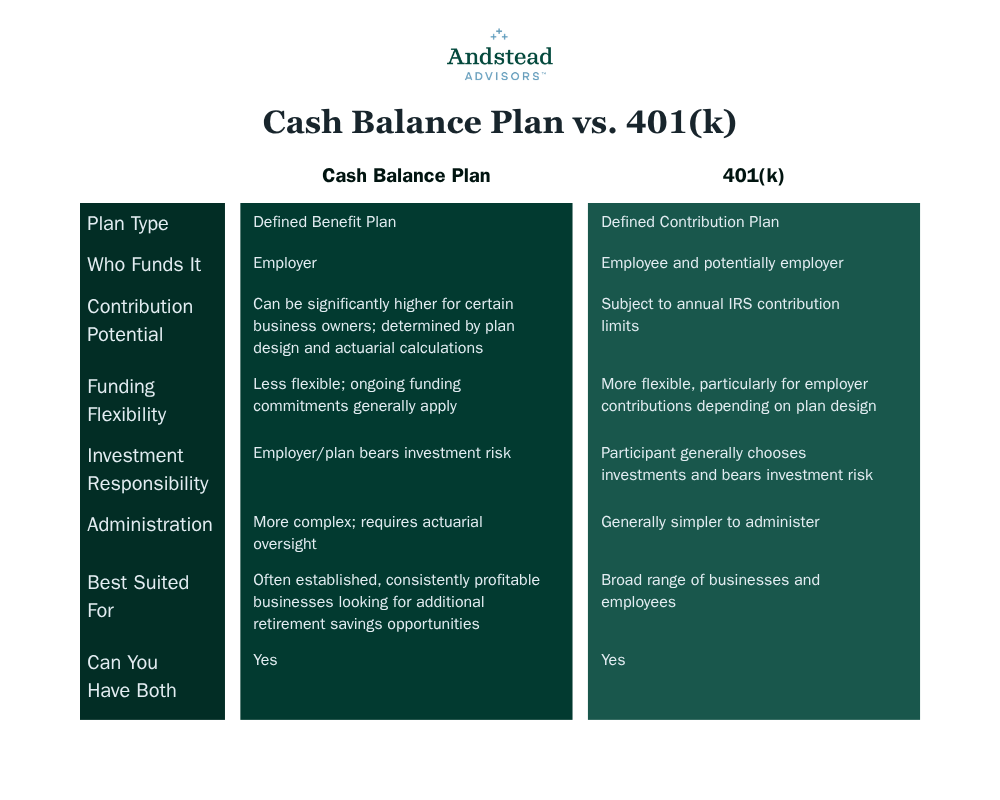
For many business owners, the real question isn't whether to choose a cash balance plan instead of a 401(k). It's whether adding a cash balance plan to an existing 401(k) and profit-sharing strategy could improve the overall retirement plan.
Who Is a Good Candidate for a Cash Balance Plan?
Cash balance plans tend to be most compelling for consistently profitable businesses with predictable cash flow. They may be particularly worth exploring when owners are already maximizing other retirement plan opportunities and want to accelerate retirement savings.
Age can also play an important role. Because defined benefit plans are designed around providing a future retirement benefit, an older business owner may be able to fund a larger benefit over a shorter period than a younger participant, depending on the plan design. The exact contribution opportunity still requires actuarial analysis rather than relying on a general age-based rule.
Employee demographics matter as well. A cash balance plan has to satisfy applicable retirement plan rules for eligible employees, so the owner cannot simply decide how much they would like to contribute personally and ignore everyone else. Understanding the ages, compensation, tenure, and number of employees is an important part of determining whether the economics of a plan make sense.
When a Cash Balance Plan May Not Make Sense
The same features that make cash balance plans powerful can also make them inappropriate for some businesses. Because these are defined benefit plans, employers take on funding responsibilities that are different from a discretionary approach to retirement savings. Defined benefit plans also generally cost more to establish and maintain and require actuarial involvement and annual filings.
A business with unpredictable cash flow may therefore need to think carefully before establishing one. If profitability varies significantly from year to year, committing to an additional retirement plan may create more pressure than benefit. The potential tax deduction shouldn't overshadow whether the business can comfortably support the plan over time.
Cash balance plans may also be less attractive when the cost of providing benefits to employees outweighs the benefit to the owners, or when the owner simply doesn't need the additional retirement savings capacity. This is why plan design and employee demographics should be evaluated before assuming a cash balance plan is the right solution.
How Much Can You Contribute to a Cash Balance Plan?
This is one of the most common questions about cash balance plans, but it's also one of the easiest to oversimplify.
Unlike a 401(k), there isn't one cash balance plan contribution number that applies to everyone. Defined benefit plan contributions are calculated based on the benefits promised under the plan and actuarial assumptions. Factors such as age, compensation, plan design, existing plan assets, and the benefits being funded can influence the required contribution.
For 2026, the IRS limits the annual benefit payable from a defined benefit plan to generally the lesser of 100% of the participant's highest three-year average compensation or $290,000, subject to the detailed rules governing these plans. That is a benefit limit, not a statement that every participant can contribute $290,000 to a cash balance plan.
This distinction matters when you see large cash balance contribution figures online. Those numbers may be possible in certain plan designs, but they shouldn't be treated as universal limits or assumed opportunities.
Can You Have a Cash Balance Plan and a 401(k)?
Yes. A business can maintain a cash balance plan alongside a 401(k), subject to the rules governing each plan. For the right business, combining a 401(k), profit-sharing component, and cash balance plan can significantly expand the overall retirement planning opportunity.
The plans need to be designed together rather than independently. Contributions, employee benefits, nondiscrimination requirements, business cash flow, and the owner's objectives all need to work within the overall retirement plan structure.
Is a Cash Balance Plan Right for Your Business?
Start with the business, not the potential contribution. Is the business consistently profitable? Is cash flow predictable enough to support ongoing funding? Are you already maximizing your existing retirement plan? Do you want to save substantially more for retirement? How would a cash balance plan affect your employees, and does the additional tax and retirement benefit justify the cost and complexity?
If those factors align, a cash balance plan can be an extremely valuable planning tool. If they don't, a 401(k), profit-sharing plan, or another retirement plan design may provide greater flexibility. The goal isn't to create the retirement plan with the biggest possible contribution. It's to create a retirement plan that works for the owner, the employees, and the business supporting it.

Frequently Asked Questions
Q: What is a cash balance plan?
A: A cash balance plan is a type of defined benefit retirement plan that expresses a participant’s benefit as a hypothetical account balance. The employer funds the plan based on a benefit formula, with required contributions determined through actuarial calculations.
Q: How does a cash balance plan work for a business owner?
A: A cash balance plan allows a business to fund retirement benefits for eligible participants based on the plan’s design. For certain business owners, particularly those with consistently profitable businesses who are already maximizing other retirement savings opportunities, it can provide significant additional retirement savings potential.
Q: How much can a business owner contribute to a cash balance plan?
A: There is not one universal cash balance plan contribution limit. Contributions depend on factors such as age, compensation, plan design, existing plan assets, and actuarial calculations. This is why a business should receive a plan-specific illustration rather than relying on general contribution figures found online.
Q: Can you have a cash balance plan and a 401(k)?
A: Yes. A business can maintain both a cash balance plan and a 401(k), subject to applicable retirement plan rules. For the right business, combining a 401(k), profit-sharing component, and cash balance plan can create additional retirement savings opportunities.
Q: Are cash balance plan contributions tax deductible?
A: Employer contributions to a qualified cash balance plan may generally be deductible by the business, subject to applicable tax rules and limitations. Business owners should coordinate plan design and contributions with their retirement plan and tax professionals.
Q: Who is a good candidate for a cash balance plan?
A: Cash balance plans may be a good fit for owners of consistently profitable businesses with predictable cash flow who want to save more for retirement than their existing plan allows. Owner age, employee demographics, compensation, and the business’s ability to support ongoing funding are also important considerations.
Q: What are the disadvantages of a cash balance plan?
A: Cash balance plans are generally more complex and expensive to administer than a 401(k), require actuarial oversight, and involve greater funding commitments. They may not be appropriate for businesses with unpredictable cash flow or when the costs and employee funding requirements outweigh the benefits to the owners.
About Andstead Advisors
Andstead Advisorsis an independent financial planning and wealth management firm headquartered in Denver's Denver Tech Center, serving individuals, families, retirees, and business ownersthroughout Colorado and across the country. Our teamprovides comprehensive financial planning, investment management, retirement planning, business owner solutions, retirement plan consulting, business succession planning, cash balance plan strategies, profit sharing plans, and Solo 401(k) guidance. As fiduciary advisors, we help clients make informed financial decisions through personalized advice, long-term planning, and ongoing partnership designed to support their financial goals at every stage of life.