


Since being signed into law, Trump Accounts have generated significant interest, and just as many questions.
What exactly is a Trump Account? Who qualifies for the $1,000 government contribution? Where can you open one? How do they compare to a 529 plan or a Roth IRA? And perhaps most importantly, should parents actually use one?
If you've been trying to make sense of the headlines, you're not alone. This guide explains how Trump Accounts work, who is eligible, how they're invested, and where they may fit into your family's overall financial plan.
Quick Answer
A Trump Account (officially called a 530A Account) is a new tax-advantaged investment account created to help children begin building long-term wealth.
Children born between January 1, 2025, and December 31, 2028, who meet the eligibility requirements, receive a $1,000 government-funded contribution. Families, employers, and other eligible contributors may then add up to $5,000 per year to the account. Investments are limited to low-cost U.S. stock market index funds, and the money generally remains invested until the child reaches adulthood.
While Trump Accounts can be a valuable savings tool, they shouldn't automatically replace other accounts such as 529 plans or retirement accounts. Instead, they should be evaluated as one part of a broader financial strategy.

What Is a Trump Account?
Trump Accounts were created as part of the One Big Beautiful Bill Act and are designed to encourage long-term investing from an early age.
The idea is straightforward: give eligible children a small investment at birth, allow family members and employers to make additional contributions, and let decades of compound growth do the heavy lifting.
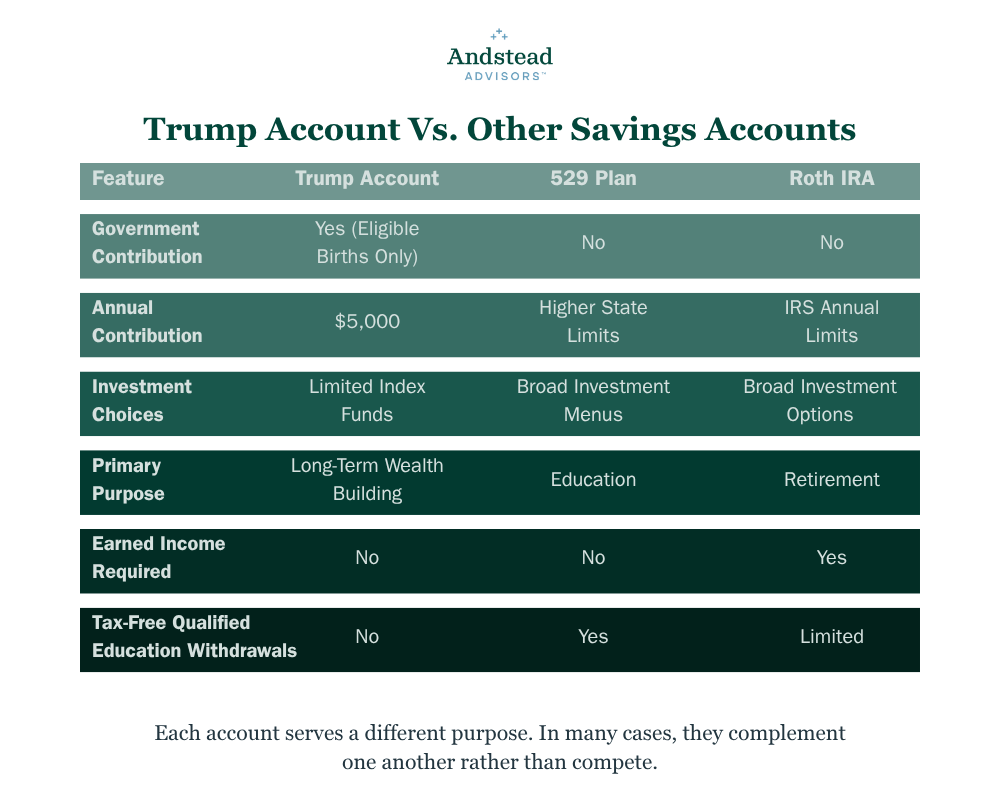
Unlike a savings account, the money is invested in the stock market. Unlike a 529 plan, the account isn't specifically designed for education expenses. And unlike a Roth IRA, eligibility doesn't depend on the child having earned income.
Who Is Eligible?
A child generally must:
- Be a U.S. citizen
- Have a valid Social Security number
- Be under age 18 when the account is established
To receive the government's $1,000 starter contribution, the child must have been born between January 1, 2025, and December 31, 2028.
Where Can You Open a Trump Account?
This is one of the biggest points of confusion.
Unlike traditional brokerage accounts, Trump Accounts cannot initially be opened at just any financial institution.
The U.S. Treasury selected BNY as the financial agent responsible for administering the program, while Robinhood provides the brokerage platform and account technology. Families generally establish their accounts through the official Trump Accounts website or app rather than by walking into a brokerage office.
As the program matures, additional financial institutions may become approved custodians for transfers or ongoing administration. However, at launch, the Treasury's designated platform is the primary way to establish an account.
How Much Can You Contribute?
In addition to the government's $1,000 contribution for eligible children, families and other eligible contributors can generally contribute up to $5,000 per child each year, with future inflation adjustments expected.
Contributions may come from:
- Parents
- Grandparents
- Other family members
- Friends
- Employers
- Qualified charitable organizations
Employer contributions are subject to separate annual limits under the law.
How Are the Investments Managed?
Unlike many brokerage accounts, Trump Accounts don't allow unlimited investment choices.
Instead, investments must be held in qualifying low-cost index funds or ETFs that broadly track the U.S. stock market. The default investment is the State Street SPDR Portfolio S&P 500 ETF (SPYM), and several other qualifying broad-market ETFs are also available. Sector funds, individual stocks, and speculative investments aren't permitted.
The purpose is to keep costs low while providing diversified exposure to the U.S. equity market.
When Can the Money Be Used?
Trump Accounts are intended to encourage long-term investing rather than short-term spending.
Generally, withdrawals cannot begin until the year the beneficiary turns 18. At that point, the account transitions to rules similar to those governing traditional IRAs, including ordinary income taxation on distributions and potential early-withdrawal penalties in certain situations.
Because the rules are still relatively new, families should review current IRS guidance before taking distributions.

Trump Account vs. Other Savings Accounts
Potential Advantages
Some of the biggest benefits include:
- $1,000 government contribution for eligible children
- Opportunity for decades of compound growth
- Simple annual contribution limits
- Low-cost diversified investments
- Potential employer and philanthropic contributions
- Encourages early investing and financial literacy
For families with newborns, even modest annual contributions may grow substantially over 18 years and beyond.
Potential Drawbacks
Like every financial planning tool, Trump Accounts also have limitations.
Some considerations include:
- Limited investment flexibility
- Annual contribution limits
- Restricted access before adulthood
- Tax treatment differs from Roth IRAs and 529 plans
- May not be the highest-priority savings vehicle for every family
Whether a Trump Account makes sense depends on your broader financial goals—not simply because it's new.
Where Does a Trump Account Fit in Your Financial Plan?
One mistake people often make is assuming every new financial account deserves immediate funding.
In reality, priorities matter.
For many families, a logical order might look like this:
- Build an emergency fund.
- Contribute enough to receive an employer retirement match.
- Pay down high-interest debt.
- Fund retirement accounts.
- Save for education if appropriate.
- Contribute to a Trump Account.
Every family is different, and the "right" order depends on your income, goals, and existing savings.
Questions to Ask Before Opening a Trump Account
Before opening an account, consider asking yourself:
- Does my child qualify for the government contribution?
- Am I already saving enough for retirement?
- Should I prioritize a 529 plan instead?
- Will I realistically make annual contributions?
- How does this account fit into my family's long-term financial plan?
- Would another savings vehicle better accomplish my goals?
Thinking through these questions can help ensure you're using the account intentionally rather than simply because it's available.
What We've Learned Helping Families
Whenever a new savings account or tax law is introduced, it's easy to assume it's automatically the best option.
In reality, every financial tool has strengths, limitations, and situations where it makes more—or less—sense.
For some families, a Trump Account may be an excellent opportunity to give a child a long-term financial head start, especially when paired with the government's initial contribution. For others, prioritizing retirement savings, building an emergency fund, or funding a 529 plan may create greater long-term value.
The goal isn't to chase the newest account. It's to build a financial plan where every account serves a purpose.
Final Thoughts
Trump Accounts represent one of the most significant new savings programs introduced for children in recent years. For eligible families, the government's $1,000 contribution and the potential for decades of compound growth make them worth understanding.
Like any financial planning decision, however, the account shouldn't be evaluated in isolation. The best strategy is one that balances retirement planning, education savings, emergency reserves, tax efficiency, and long-term family goals.
Rather than asking, "Should I open a Trump Account?", a better question is, "Where does a Trump Account fit within my family's overall financial plan?" That's the question most likely to lead to a confident, well-informed decision.

About Andstead Advisors
Andstead Advisors is an independent financial planning and wealth management firm headquartered in Denver's Denver Tech Center, serving individuals, families, retirees, and business owners throughout Colorado and across the country. Our team provides comprehensive financial planning, investment management, retirement planning, business owner solutions, retirement plan consulting, business succession planning, cash balance plan strategies, profit sharing plans, and Solo 401(k) guidance. As fiduciary advisors, we help clients make informed financial decisions through personalized advice, long-term planning, and ongoing partnership designed to support their financial goals at every stage of life.