


For many people, paying off the mortgage before retirement feels like an obvious goal. Eliminating a monthly payment can reduce retirement expenses, simplify your finances, and provide the peace of mind that comes with entering retirement debt-free.
But paying off your mortgage before retirement isn't always the best financial decision. Your mortgage rate matters, but so do your retirement savings, taxes, cash flow, liquidity, and the source of the money you would use to pay off the loan. The right decision comes from looking at the mortgage as one part of your overall retirement plan.
Should You Pay Off Your Mortgage Before You Retire?
Paying off your mortgage before retirement may make sense if you can eliminate the debt without significantly reducing your retirement savings or cash reserves. It can be especially attractive when your mortgage rate is relatively high, the payment represents a meaningful portion of your monthly expenses, or becoming debt-free is personally important to you.
Keeping the mortgage may make more sense if you have a low fixed interest rate, the payment fits comfortably within your retirement income plan, or paying it off would require you to use assets that are important to your long-term financial security. There isn't one answer that works for every retiree, which is why the decision should begin with your entire financial picture rather than the mortgage balance alone.

Start With Your Mortgage Rate
Your mortgage interest rate is an important part of the decision because paying down the loan gives you a predictable benefit: you avoid future interest on the debt. A higher mortgage rate can make paying it off more attractive, while a low fixed rate may make keeping the loan easier to justify.
The comparison isn't quite as simple as asking whether your investments might earn more than your mortgage costs. Investment returns aren't guaranteed, and retirement planning involves more than maximizing expected returns. Your risk tolerance, retirement timeline, savings level, and need for accessible cash should all factor into the decision.
Where Will the Money to Pay Off Your Mortgage Come From?
This is one of the most important questions to answer. Imagine you're approaching retirement with a $300,000 mortgage and enough investments to eliminate it. On paper, you can afford to pay off the house, but the financial impact can look very different depending on where that $300,000 comes from.
Excess cash, a taxable brokerage account, a traditional IRA or 401(k), and a Roth account can each create different tradeoffs. For example, a large withdrawal from a traditional retirement account is generally taxable, so you may need to withdraw more than the mortgage balance to produce enough after-tax cash for the payoff. Selling investments can also reduce liquidity and the amount of money that remains invested for retirement.
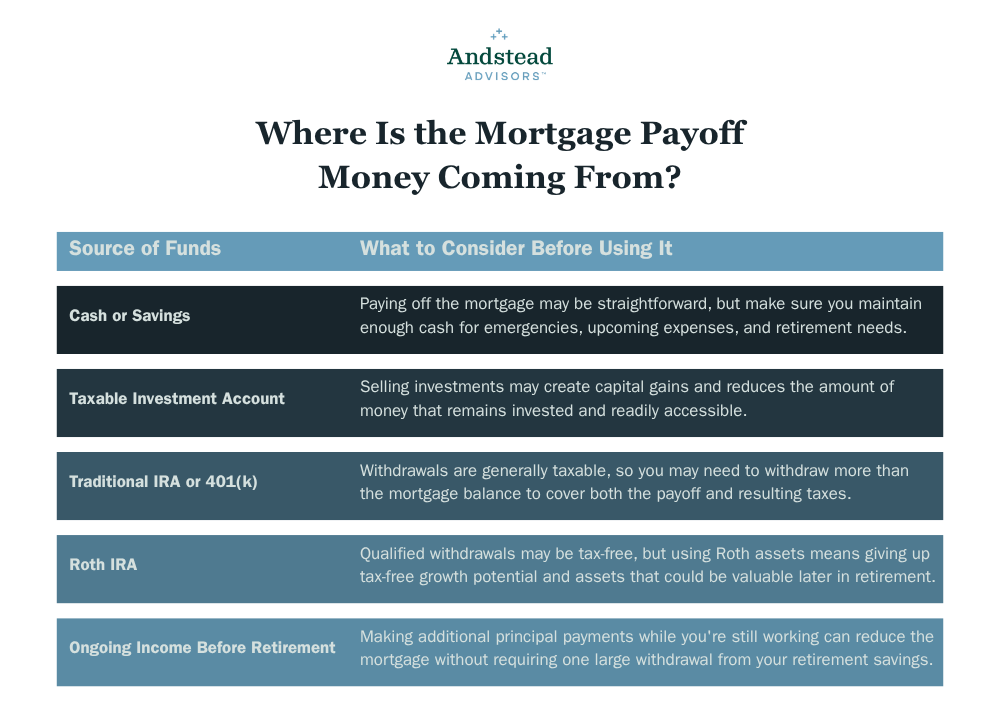
Before asking whether you have enough money to pay off your mortgage, consider what your financial position would look like afterward. Eliminating the debt may feel good, but not if doing so leaves too little available for the rest of retirement.
Consider Your Retirement Cash Flow
One of the strongest arguments for paying off a mortgage before retirement is the reduction in monthly expenses. If your principal and interest payment is $2,500 per month, eliminating it could reduce your annual cash-flow needs by $30,000. That may mean needing less income from your investment portfolio each year, which can be particularly helpful during periods of market volatility.
However, a paid-off mortgage doesn't mean housing becomes free. Property taxes, homeowners insurance, maintenance, HOA or condo fees, and other housing expenses may continue. When estimating how much your retirement expenses will actually decline, separate the principal and interest that disappear from the housing costs that remain.
Don't Overlook Liquidity
Paying off a mortgage essentially exchanges liquid assets for additional home equity. That can improve monthly cash flow, but it can also leave less money readily available for healthcare expenses, home repairs, travel, emergencies, or other retirement needs.
Someone can have a valuable paid-off home and still have limited financial flexibility if too much of their wealth is tied up in the property. Before making a large mortgage payoff, consider how much cash and accessible investments you'll have left. Entering retirement without a mortgage can be valuable, but so can entering retirement with sufficient liquidity.
When Paying Off Your Mortgage May Make Sense
Paying off your mortgage before retirement may be attractive when your retirement savings are already on track, you will maintain adequate cash reserves after the payoff, and eliminating the payment meaningfully improves your retirement cash flow. A higher mortgage rate can strengthen the case, particularly when compared with the return you could reasonably expect from lower-risk alternatives.
The emotional benefit matters too. If being mortgage-free provides significant peace of mind and your financial plan comfortably supports the decision, that is a legitimate consideration. Retirement planning isn't solely about finding the mathematically optimal outcome; the plan also has to work for the person living it.

When Keeping Your Mortgage May Make Sense
Keeping the mortgage may be reasonable when you have a low fixed interest rate and the payment fits comfortably within your retirement income plan. It may also be preferable if paying off the loan would require a large taxable retirement-account withdrawal, substantially reduce your investment portfolio, or leave you without enough accessible savings.
You should also consider your other priorities. If you're still building retirement savings or carrying higher-interest debt, directing every available dollar toward a relatively inexpensive mortgage may not put you in the strongest overall position.
It Doesn't Have to Be All or Nothing
Your choices aren't limited to paying off the mortgage immediately or keeping it for the remainder of the original term. You could make additional principal payments while you're still working, direct bonuses or other excess cash toward the loan, or simply plan for the mortgage to be paid off a few years into retirement.
For some people, a gradual approach provides a better balance between reducing debt and preserving retirement savings. There is nothing inherently significant about having a zero mortgage balance on your exact retirement date if the loan can be comfortably managed within your plan.
Don't Optimize the Mortgage. Optimize Your Retirement Plan.
The goal isn't necessarily to retire with no mortgage. It's to enter retirement with enough income to support your lifestyle, enough liquidity to handle the unexpected, and enough flexibility to adapt as your needs change.
Before paying off your mortgage, compare what retirement looks like both ways. Consider the monthly expenses you'll eliminate, the assets you'll use to pay off the loan, any potential tax consequences, how much liquidity you'll have afterward, and how important being debt-free is to you.
Sometimes paying off the mortgage puts the retirement plan in a stronger position. Sometimes keeping it does. The better question isn't simply “Can I pay off my mortgage before retirement?” It's “Which choice gives me the stronger retirement plan?”

Frequently Asked Questions
Q: Should I pay off my mortgage before retirement?
A: It depends on your overall financial situation. Paying off your mortgage before retirement may make sense if you can do so while maintaining sufficient retirement savings and liquidity. Keeping the mortgage may make more sense if you have a low interest rate or would need to significantly reduce your investments to pay it off.
Q: Is it better to retire with or without a mortgage?
A: Retiring without a mortgage can lower your monthly expenses and reduce the amount of income you need in retirement, but being mortgage-free isn't automatically better. Your retirement savings, cash flow, liquidity, mortgage rate, and tax situation should all factor into the decision.
Q: Should I use my retirement savings to pay off my mortgage?
A: Using retirement savings to pay off a mortgage requires careful consideration. Withdrawals from a traditional IRA or 401(k) are generally taxable, and a large withdrawal could create a significant tax bill while reducing the assets available to support your future retirement income.
Q: Should I pay off a low-interest mortgage before retirement?
A: Not necessarily. A low fixed-rate mortgage may be manageable within your retirement plan, particularly if paying it off would significantly reduce your liquid savings or investment portfolio. The mortgage rate should be considered alongside your cash flow, taxes, investment strategy, and personal preference.
Q: What are the benefits of paying off your mortgage before retirement?
A: Paying off your mortgage can reduce monthly expenses, decrease the amount of income you need from investments, eliminate future mortgage interest, and provide peace of mind. The benefits are greatest when the payoff doesn't compromise other important retirement goals.
Q: What are the disadvantages of paying off your mortgage before retirement?
A: Paying off a mortgage can reduce your available cash and investments, potentially create taxes depending on where the money comes from, and concentrate more of your net worth in your home. These tradeoffs are especially important to consider when you're approaching retirement.
Q: Can I gradually pay off my mortgage before retirement instead?
A: Yes. Making additional principal payments while you're still working can reduce your mortgage balance without requiring one large withdrawal from your savings. For some people, gradually paying down the mortgage provides a better balance between reducing debt and preserving liquidity.
About Andstead Advisors
Andstead Advisorsis an independent financial planning and wealth management firm headquartered in Denver's Denver Tech Center, serving individuals, families, retirees, and business ownersthroughout Colorado and across the country. Our teamprovides comprehensive financial planning, investment management, retirement planning, business owner solutions, retirement plan consulting, business succession planning, cash balance plan strategies, profit sharing plans, and Solo 401(k) guidance. As fiduciary advisors, we help clients make informed financial decisions through personalized advice, long-term planning, and ongoing partnership designed to support their financial goals at every stage of life.