


The IRS has announced the retirement account contribution limits for 2027. While contribution limits for workplace retirement plans are increasing, the annual IRA contribution limit will remain unchanged.
The updates include higher 401(k) contribution limits, increased catch-up contributions for certain age groups, and adjusted income thresholds for Roth IRA eligibility.
Here's a breakdown of what's changing for 2027.
2027 401(k), 403(b), and 457 Contribution Limits
For 2027, employees participating in most 401(k), 403(b), governmental 457 plans, and the federal Thrift Savings Plan can contribute up to $25,500, an increase of $1,000 from 2026.
Catch-up contribution limits are also increasing for individuals age 50 and older.
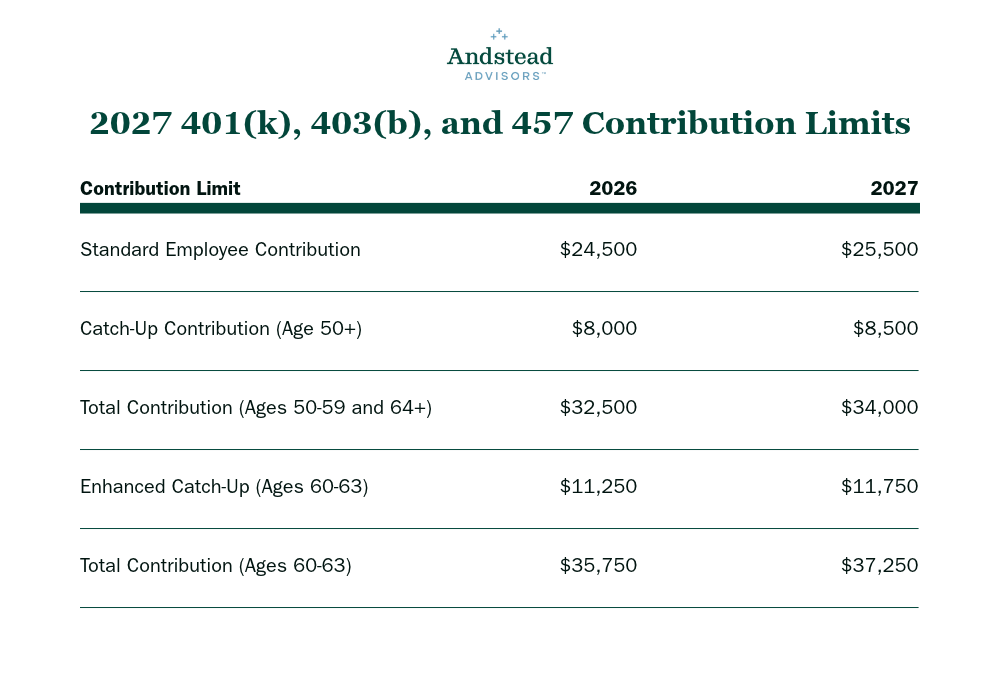
The enhanced catch-up contribution for individuals ages 60 through 63 was introduced under the SECURE 2.0 Act. These limits apply to eligible employee contributions and do not include employer contributions.
Total Employee and Employer Contribution Limits
For 2027, the overall defined contribution limit for plans such as 401(k)s increases to $75,000, up from $72,000 in 2026.
This limit generally includes employee contributions, employer matching contributions, and employer profit-sharing contributions. Eligible catch-up contributions are permitted in addition to this limit.
For business owners, understanding both employee and employer contribution limits can be especially important when evaluating retirement plan options.
Learn more in our article, What Is the Best Retirement Plan for a Small Business Owner?
New Roth Catch-Up Requirements for Higher Earners
Beginning in 2026, certain higher-income employees are required to make their workplace retirement plan catch-up contributions on a Roth, or after-tax, basis.
For 2027, this requirement generally applies to employees whose prior-year Social Security wages from the employer sponsoring the plan exceeded $155,000 in 2026.
Employees subject to this requirement can still make catch-up contributions, but those contributions must be designated as Roth rather than traditional pretax contributions.
The requirement applies to catch-up contributions, not necessarily an employee's regular retirement plan contributions. Plan-specific rules and exceptions may apply.
2027 IRA Contribution Limits
The annual contribution limit for traditional and Roth IRAs remains $7,500 in 2027. Individuals age 50 and older can make an additional $1,100 catch-up contribution, bringing their total to $8,600.
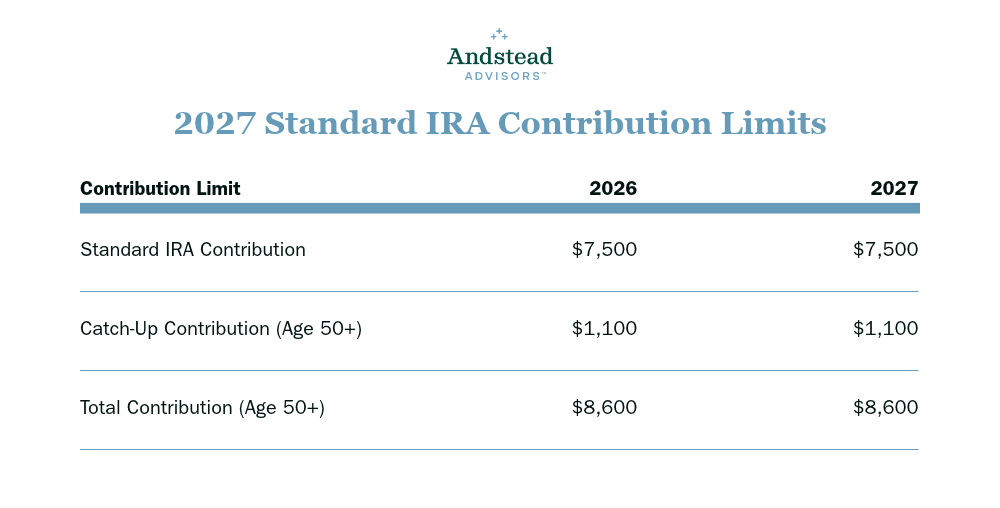
The IRA contribution limit applies to combined contributions across traditional and Roth IRAs, not separately to each account. Contributions are also subject to applicable eligibility and compensation requirements.
2027 Roth IRA Income Limits
Although Roth IRA contribution limits remain unchanged, the income ranges determining eligibility to contribute directly to a Roth IRA are increasing.
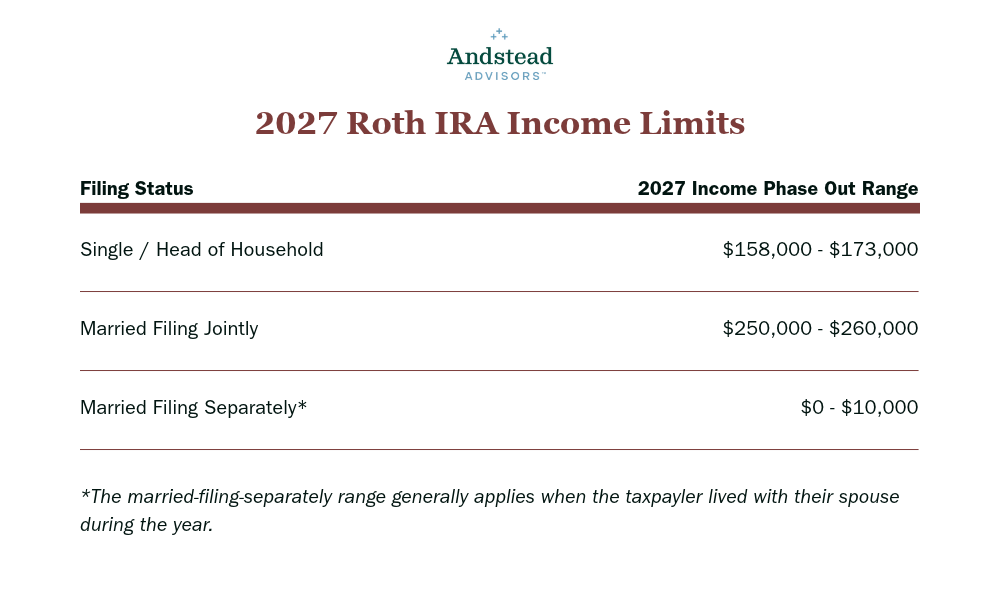
Taxpayers whose modified adjusted gross income falls within these ranges may have their allowable Roth IRA contribution reduced or eliminated.
Traditional IRA contributions may also be subject to income-based deduction limits when the taxpayer or their spouse participates in a workplace retirement plan.
For a closer look at how these accounts compare, read our article on Roth IRA vs. Traditional IRA.
2027 SIMPLE IRA Contribution Limits
The standard employee contribution limit for SIMPLE retirement plans is increasing from $17,000 in 2026 to $17,500 in 2027.
Certain eligible SIMPLE plans may allow a higher contribution limit of $19,100.
For most SIMPLE plans, the catch-up contribution limit remains $4,000 for participants age 50 and older. Different limits apply to certain eligible plans, and the enhanced catch-up contribution for participants ages 60 through 63 remains $5,250.
Planning for 2027
The updated contribution limits provide an opportunity to review retirement savings strategies before the new year. Employees may want to revisit their payroll deferrals, while business owners should consider how retirement plan contributions fit into their broader business and personal financial goals.
At Andstead Advisors, we help individuals, families, and business owners coordinate retirement savings with their long-term financial plans. If you have questions about your retirement contribution strategy for 2027, our team is here to help.

Frequently Asked Questions
Q: What is the maximum 401(k) contribution for 2027?
A: The employee contribution limit for 2027 is $25,500, an increase of $1,000 from 2026. Employees age 50 and older may also qualify for additional catch-up contributions.
Q: How much can someone over age 50 contribute to a 401(k) in 2027?
A: Individuals ages 50–59 and 64 or older can contribute up to $34,000, including the $8,500 catch-up contribution. Those ages 60–63 may contribute up to $37,250 through the enhanced catch-up provision, if eligible.
Q: What is the IRA contribution limit for 2027?
A: The annual contribution limit for traditional and Roth IRAs remains $7,500 in 2027. Individuals age 50 and older can contribute an additional $1,100, bringing their total to $8,600. These limits apply to combined contributions across traditional and Roth IRAs.
Q: What is the maximum combined employee and employer 401(k) contribution for 2027?
A: The overall defined contribution limit increases to $75,000 in 2027, excluding eligible catch-up contributions. This generally includes employee deferrals, employer matching contributions, and profit-sharing contributions, subject to applicable plan rules.
Q: Are catch-up contributions required to be Roth contributions in 2027?
A: Certain higher-income employees must make catch-up contributions on a Roth basis. For 2027, this generally applies to employees whose 2026 Social Security wages from the employer sponsoring the plan exceeded $155,000. Employees below that threshold may still have the option to make traditional pretax catch-up contributions, depending on their plan.
Q: Are Roth IRA income limits increasing in 2027?
A: Yes. For 2027, the Roth IRA contribution phase-out range is $158,000–$173,000 for single filers and $250,000–$260,000 for married couples filing jointly. Eligibility depends on modified adjusted gross income and filing status.
Q: When do the 2027 retirement contribution limits take effect?
A: The updated limits generally apply beginning January 1, 2027. Workplace retirement plan contributions typically must be made during the calendar year, while eligible IRA contributions for 2027 can generally be made until the federal tax filing deadline in 2028., our team is here to help.
About Andstead Advisors
Andstead Advisors is an independent financial planning and wealth management firm headquartered in Denver's Denver Tech Center, serving individuals, families, retirees, and business owners throughout Colorado and across the country. Our team provides comprehensive financial planning, investment management, retirement planning, business owner solutions, retirement plan consulting, business succession planning, cash balance plan strategies, profit sharing plans, and Solo 401(k) guidance. As fiduciary advisors, we help clients make informed financial decisions through personalized advice, long-term planning, and ongoing partnership designed to support their financial goals at every stage of life.